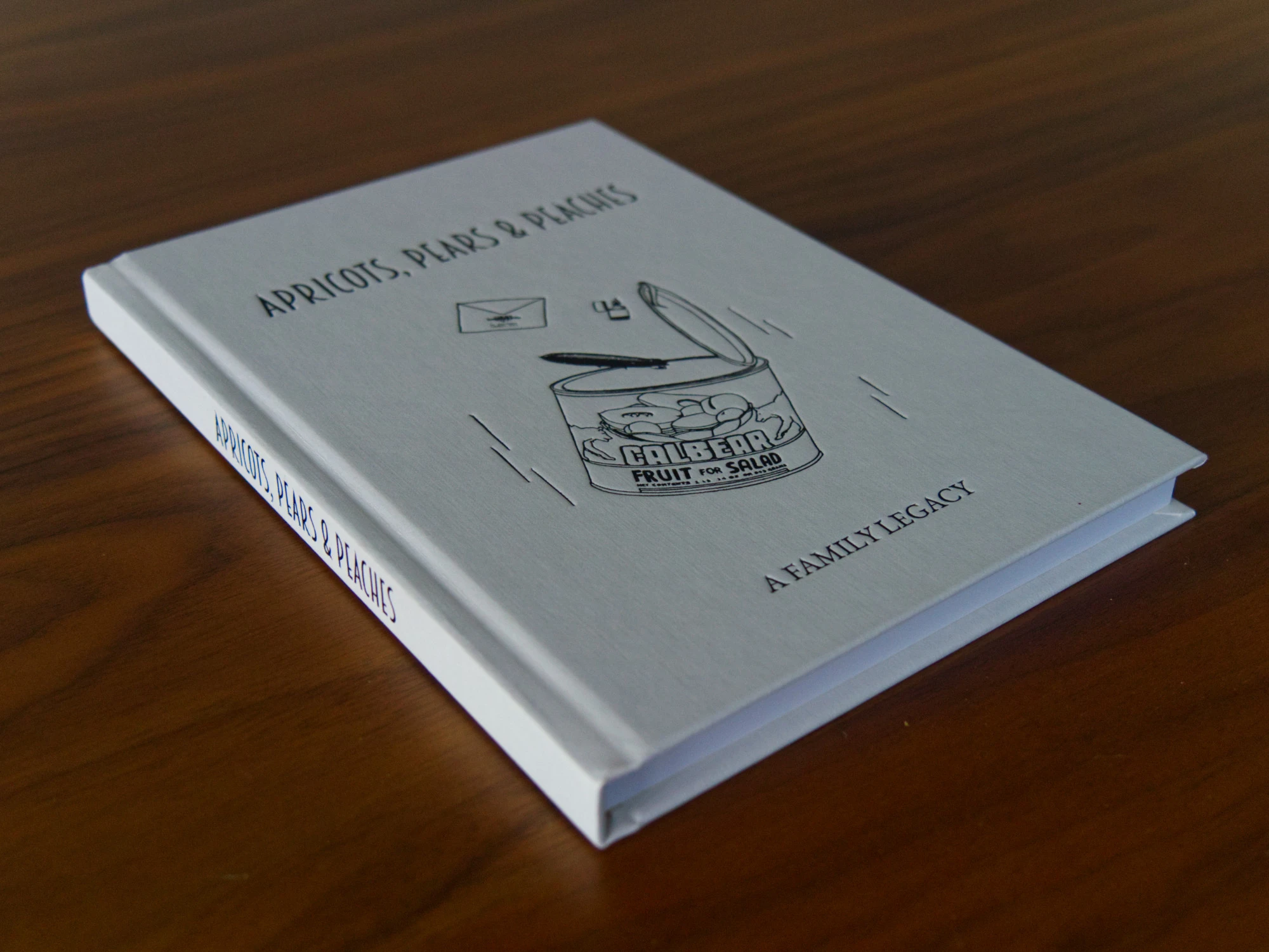
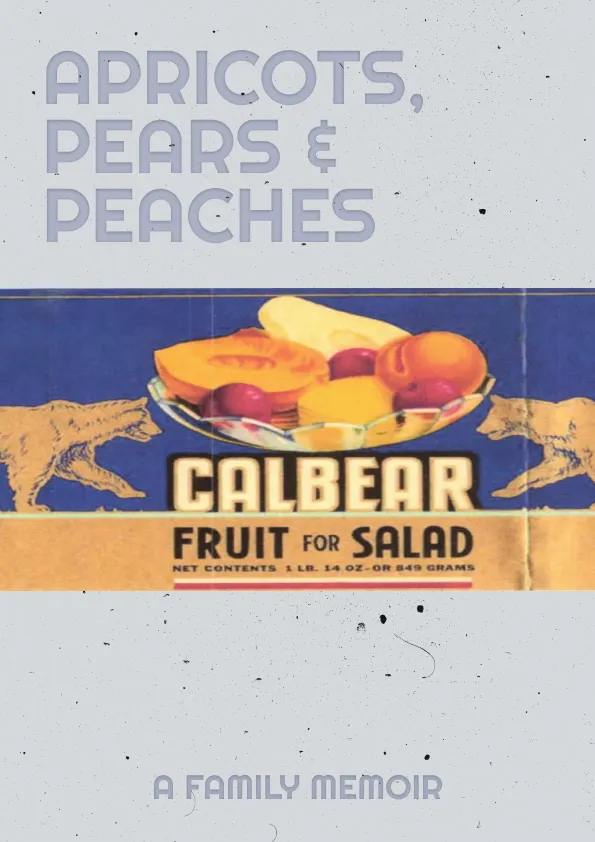
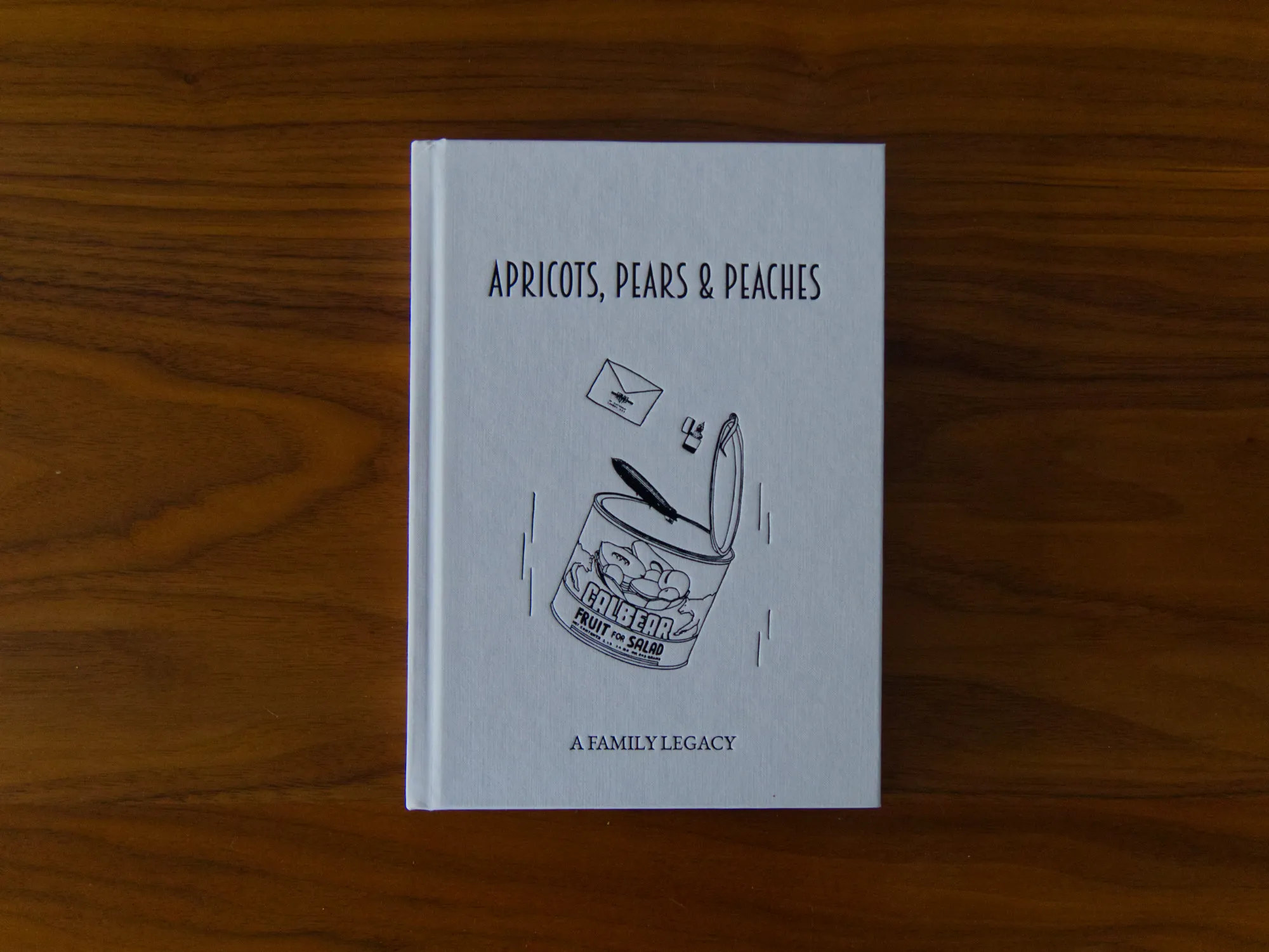
Apricots, Pears & Peaches is an experiment in preserving a family legacy. You can read more about it and access a preview here. It’s not my family, rather my friend’s. It all started when he shared some anecdotes: the Hindenburg’s 1937 last flight, Kristallnacht in 1938, the internment of German refugees on the Isle of Man in 1940, the Berlin Wall coming up in 1961 – his relatives were then and there, with all of the consequences. The thread that I saw was one of guts, resilience and rebuilding life after fate acts out its whims on you. There were letters, photos, anecdotes, interviews, characters larger than life and a few people to talk to. My friend wanted an engaging story, not a dull tome of facts. I had full creative freedom. What could go wrong? The result is a book that I wrote, designed and self-published in 4 months (working full-time on it). Below are some lessons that I extracted from the process.
Let me say it. I’m not suggesting that books should take 4 months to write – I might even advise against that. And I’m not here to pound my chest and shout: “Hey, look how quickly I can write a book!”. That would be missing the point about writing. When you finish a book, you are a different person, as Annie Dillard puts it. The first 9 weeks that it took me to get to an end-to-end draft felt like many more months. Time expanded, just like when you go travelling to an unfamiliar place. Below are some tools and approaches that I used to finish the first edition and not say years later “I’m almost done” for the nth time.
Lesson 1 - The power of fiction
From the very start, I felt the book would lend itself to a set of interweaving narratives. I settled on two main threads: Moritz, aboard the Hindenburg’s last flight, thinking about how to save his 11 siblings from Nazi Germany and Günter, a 9-year old trying to make sense of the Third Reich as a half-Jewish kid.
“How much fiction do we need?” – I pondered that a lot. Historical fiction was new to me. The challenge felt like walking on a tight rope between two skyscrapers - I couldn’t rely on aliens, the supernatural or magic and I didn’t want to use obvious tropes (Oh, he had a bomb on him!). How do I write an engaging story about a flight that until its final 32 seconds was pretty uneventful?
That’s when I turned to writing character biographies with some poetic license. I started from the facts and then I let myself veer into fiction when it felt right. I learned that fiction, if you want to do it right, leads you to deeper research into facts: commercial airship history, the Prohibition, the contents of school lessons in Nazi Germany, the 1906 San Francisco Earthquake, what happened in 1937 month by month, the musical hits of the 30s, East German police reports of 1961. There are many levels on which to use your imagination - thoughts, lines uttered, objects present and whether something happened at all or not. The power of fiction emerged in two subtle ways. First, as a driver for directed and efficient research. Second, as a way to immerse readers into historical moments and help them feel like they are right then and there. As the writer, it felt like magic.
Writing aside, I think fiction lets us shape the narratives that we have about our families. We can’t change history, sure. But there’s creative power in trying to ask “what if?” and “how might?” about our family’s history.
I once came across a family ritual where they would sit together and draw specific memories of the late grandfather. He loved the visual arts. They sketched and doodled on paper and iPads and then went around telling a story about their favourite moment. They laughed at each other’s drawings and the details they all remembered and misremembered. They felt like grandpa was there with them again. What a way to remember someone’s essence. That is where the power of fiction lies - in being okay with creation.
Lesson 2 - Product thinking
“Product” is such a loaded word. Here, I’m going to refer to the spirit of building something while keeping in mind the Venn diagrams of UX, tech and business (or: feasibility, desirability and viability). These constraints also exist in making a book, not just writing one. Throughout the four months I had the full book experience in mind, from the words to the design to the typesetting. These activities/tools/approaches helped me get it done and elevate quality.
-
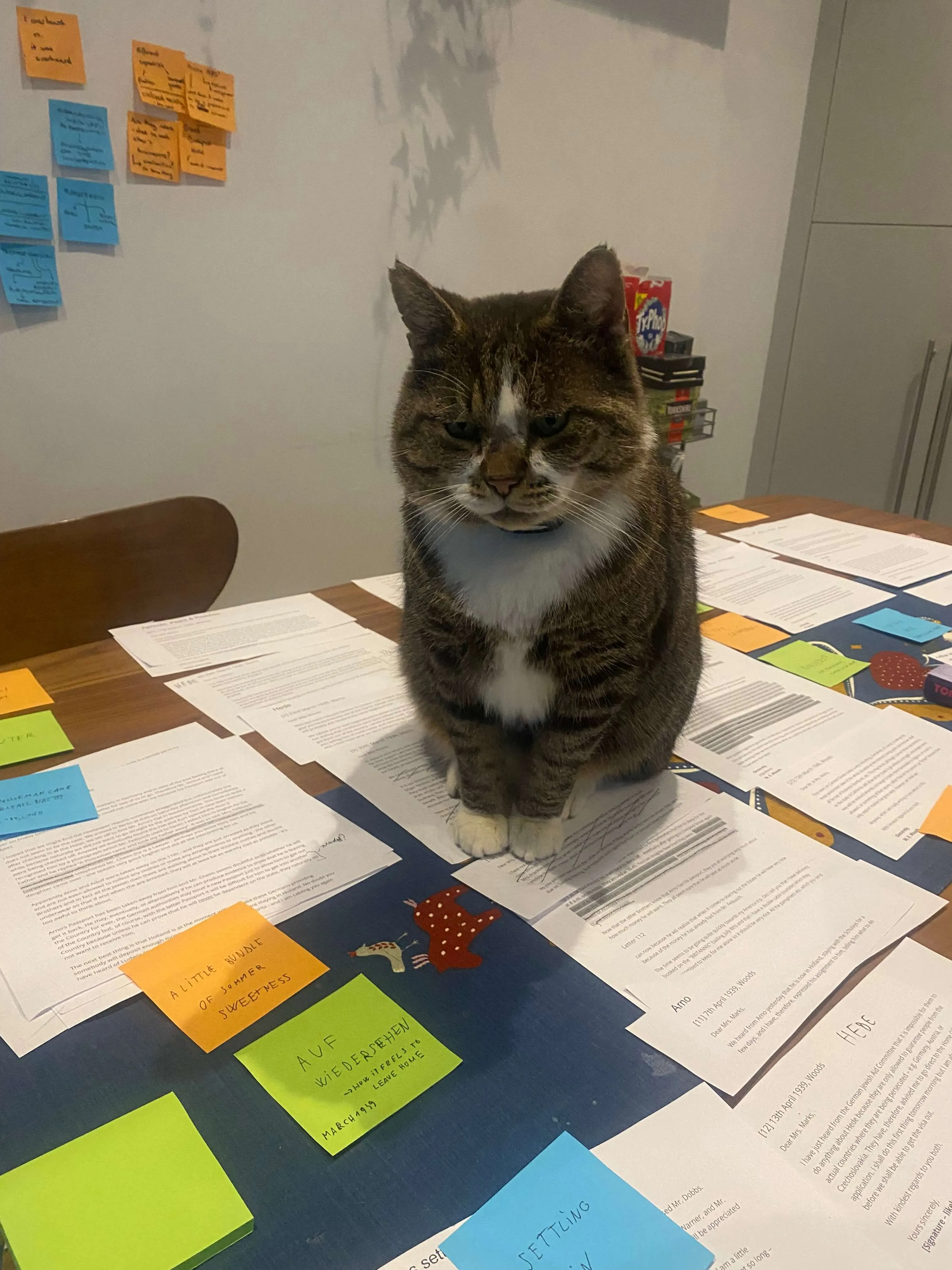
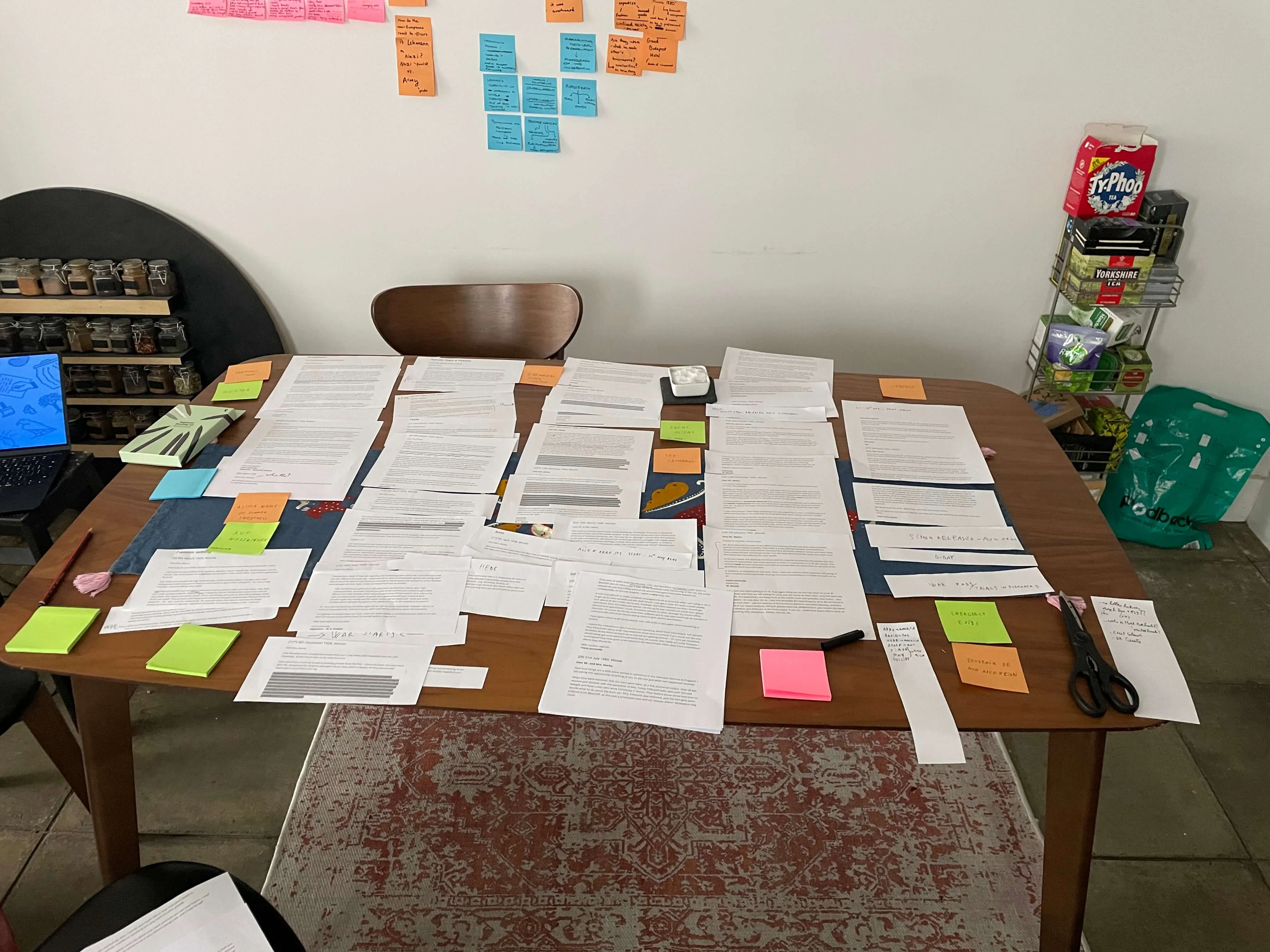
Book lunches – Invite 2-6 of your friends, cook them a meal (wine is optional), take them through narrative sticky notes and give them chapters to read if you’re ready. This is how I got feedback and observed friction points in the plot, in the reading experience and in my attempts at finding “my voice”. It requires vulnerability, but it’s a great way to connect to your friends and get reading recommendations. Many writers are rightfully wary of feedback, but in my case, early on in the first 9 weeks, these conversations helped articulate what was plausible in the story, what didn’t sit right and what historical context someone might need for events almost 100 years old. The other great benefit of organising book lunches was that they gave me a deadline - I must have something to show!
-
The compass - or What do we want from this book? Why are we writing this in the first place? Who is this book for? What would we like the impact to be in 5 or 10 years? At the start, my friend and I workshoped these questions in Miro. We returned to the initial answers when reviewing major drafts to see where we are and how close we were to these initial thoughts. Some dimensions became even more relevant, others less so and we dropped them. The book and its intention evolved and morphed throughout the process, which is usually what happens when you build a product. I learned to stop at different moments in the process and ask myself: “What are we trying to do here?”
-
Good old prioritisation & agile - ah, a lot has been said and written about this in the world of software. I’m not going to repeat it all, apart from just saying that adding some sticky notes in Miro, sizing your research tasks and prioritising based on value and impact on advancing the story helped me not waste time and focus on what was critical to move forward.
-
Iteration & process - Good things can come out of following a process. That’s why, if relevant to your project, at least trying to articulate the Three Acts in your plot is a good thing. Or writing character biographies. Or reading books on writing dialogue or screenwriting. At times, it felt like Indiana Jones, who needed to jump to the other side, but to get there, he had to jump on a rotten wooden ledge as a stepping stone. All of these exercises, books and materials are leaps to get you to the other side. You might use them or not. And as long as you’re moving ahead, you’re sharpening your thoughts on what you want to write.
-
Print a homunculus - Once you get a first or second draft in print form, you realise that you have a deformed creature in front of you. Time to perform surgery on the little monster (or make it even weirder, it’s up to you). These days, there are print-on-demand services that will print, bind and ship 2 hardback copies for about £30-35 or your local equivalent (e.g. Mixam, IngramSpark). It’s a great way to get to what we would call an alpha or a beta release in software. Reading the book as a physical manuscript helped me do huge edits, spot mistakes and reflect on the kind of book that I want at the end of the process.
Throughout the four months I had the full book experience in mind, from the words to the design to the setting. These techniques (activities? approaches?) helped me get it done and elevate quality.
Lesson 3 - Confidence
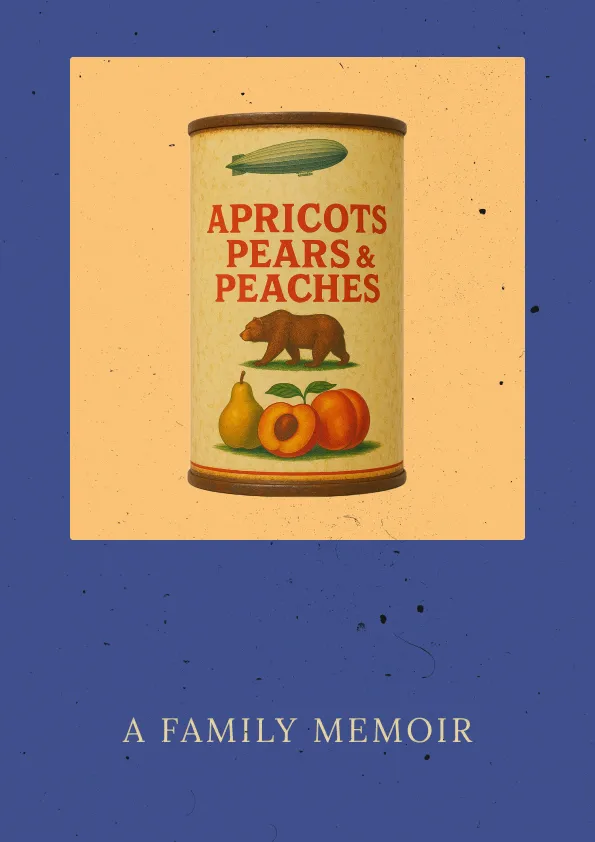
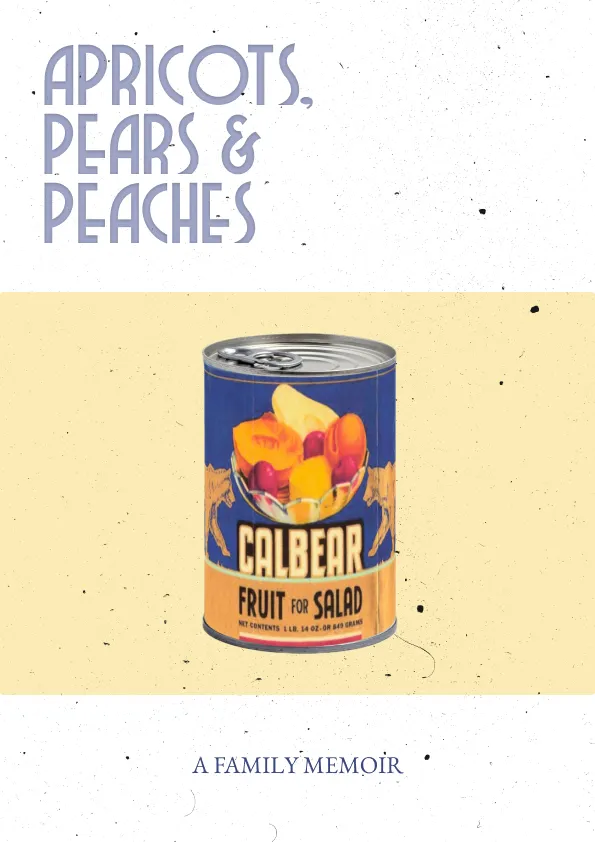
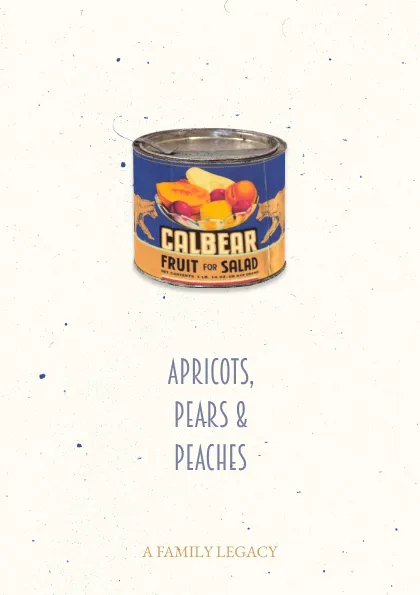
Boy, did I learn a lot about that. My first instinct in both writing and design was to shout. Not at those around me, but metaphorically at my reader. I screamed, I think, to get attention – HEY, PLEASE PAY ATTENTION, TURN THE PAGE AND LIKE WHAT I WROTE HERE. I noticed it in the overuse of choppy sentences, in the much-too-many jokes, in the big font of chapter titles and in the cover design. Once I calmed down (seeing a first printed copy helped!), I found confidence somewhere in that process. I realised that it’s okay, I don’t have to “shout”. I suppose this is similar to finding your voice and as advice goes, you have to write the first 60 pages of crappy dialogue to get it all out. Then you can start writing and designing from a place of confidence.
Lesson 4 - Family trees
If you don’t have a family tree, build one (if you can). My family didn’t have one. The project inspired me to put that right. I asked my grandparents about our common ancestors. Both of my living grandparents have some degree of the haze that comes with old age. For years, I struggled to reconnect with them. Their essence had been taken away. But questions about their lineage reanimated them. It gave them a chance to engage in that beautiful exercise of family mythology. I didn’t know my great-grandfather owned a small-town restaurant before the Communists in Romania took it away from him. Is it true? Maybe not. But it gave me a way to connect to my grandfather and place a piece in that big puzzle of “Where do I come from, really?”
Other scattered reflections
- If you want to self-publish a fine art limited edition, work with a small printer. They care a lot more than the big companies. It’s different, of course, if you don’t want so much control over the look and feel of the book.
- You will always underestimate the amount of research needed (edit: that’s apparently called Hofstadter’s Law).
- Miro is a fantastic tool to think through a book if you like working visually.
- Walking and exercising after 3-4 hours of writing and working on a plot really helps your subconscious come up with new ideas and answers. Make sure to write them all down.
- Paraphrasing Nietzsche: “Work on the thought, not the style. The former will automatically improve the latter.”
- “The hardest thing about writing is knowing what to write.” - SO TRUE!
- “ChatGPT, please write a best-selling novel that can also be adapted into a movie. Make no mistakes.” - LLMs are actually so bad at writing, once you realise that writing is so much more than putting words on a blank page (it is that as well, of course). I tried to see how they could help me. Beyond exploring semantic nuances, research, finding new sources, brainstorming and finding new words, they are so bad at writing. It feels like eating and producing plastic. At times, when tired and succumbing to get an LLM to “make it better”, I felt ashamed afterwards - I realised that I just needed the confidence to write and to just plop myself in front of the computer for hours.
I hope some of these will help others exploring family histories or trying to get their writing projects to an end. I wrote this book with no editor, partially because of the timeline and partially because we had no money to spend. I’m planning to do a second edition through Kickstarter. If you want to read the book, see a preview here. And if you’re interested, let me know by subscribing below. Once I get ~300 people interested, we’ll go ahead with a fine art edition.
Sign up below if you want a printed copy